Intro to the Sermon on the Mount
Jesus’ most well-known set of teachings is embodied in the form of a brilliant sermon marking the beginning of his ministry, delivered on a hillside on the shore of the Sea of Galilee.
The following material is mainly from The Bible Project’s video series beginning with ‘Intro to Sermon on the Mount’.
These 2,000-year-old sayings are all contained in the Sermon on the Mount:
- Love your neighbor as yourself.
- Do to others as you would have them do to you.
- You are the salt of the earth.
- You cannot serve both God and Money.
- Take the plank out of your own eye before you remove the speck from your brother’s eye.
- If anyone strikes you on the left cheek, turn and offer him the right cheek also.
- Love your enemies, and bless those who persecute you.
Jesus and his message bear striking resemblance to Moses and his message.
More than 1,300 years earlier, at the threshold of the land, Moses placed a similar vision and challenge before his hearers:
See, I have placed before you today life and happiness, and death and adversity, in that I am commanding you today to love the Lord your God, to walk in His ways and to keep His commandments, His statutes, and His judgments, so that you may live and become numerous, and that the Lord your God may bless you in the land where you are entering to take possession of it.
–Deuteronomy 30:15-16
Jesus similarly sets forth his vision of the good life and happiness, of the character of God’s people and kingdom, and of the consequences of ignoring his words. Jesus’ vision is deeply rooted in what has come before, but goes far beyond, fulfilling what was foreshadowed.
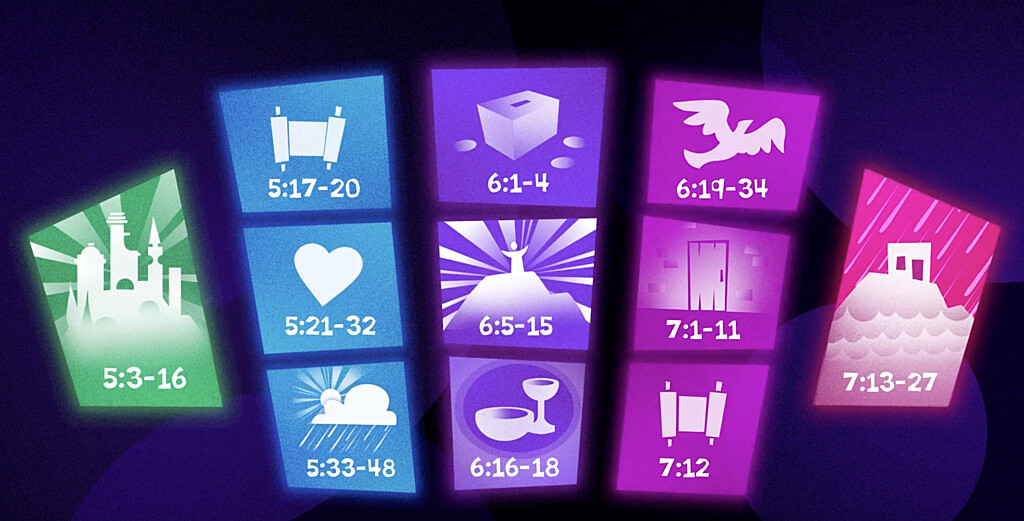
The sermon is beautifully organized in a chiasm–a symmetrical structure common in ancient literature in order to make an oral text easier to remember and meditate on. The chiasm is triply nested: The sermon itself has three main sections; each of those sections has three sections; and each of the three middle sections also has three sections.
In the three main sections…

- 5:3-16 - Jesus first announces the kind of people who belong to God’s Kingdom (5:3-16, the Beatitudes). The surprise announcement: The good life of God’s kingdom has come to the least likely people.
- 5:17-7:12 - Jesus then describes the character of such a people’s life (5:17-7:12),
- 7:13-27 - Finally, Jesus challenges his hearers to choose whether they will actually live and develop into that kind of people (7:13-27).
Introduction, 5:3-16 - The beatitudes, salt, and light
Jesus presents three images of kingdom people:
- 5:3-12 The nine-fold good life - the beatitudes
- 5:13 Salt of the land
- 5:14-16 Light and city on the hill
How to live the good life, 5:17-7:12
The middle “character” section is further divided into the three dimensions of human life: Wisdom, Worship, and the World…

- Wisdom, 5:17-48 - The Torah and the Prophets as the foundation and source of how to build character and conduct relationships
- Worship, 6:1-18 - A righteous community living before the eyes of God, not the eyes of people.
- World, 6:19-7:12 - Becoming a people who trust God’s provision and practice wise, loving relationships in the world.
Each of these parts has three parts:
(By the way, a symmetrical literary structure naturally invites the reader toward its center, where is found the main point, or the “treasure” of the text. Can you identify the “treasure” text–the theological heart–of the Sermon on the Mount?
The character of citizens of the kingdom of God, 5:17-7:12
In the main body, Jesus teaches how to do right by God and others. Jesus defines righteousness in terms of people’s character and core motivations, in contrast to external, observable behavior which can be deceiving. Righteousness is expressed in relationships: less “What should I do?” and more “What kind of person should I be?” and “With whom shall I become that kind of person?”
Righteousness is lived out in community. For instance, the Lord’s prayer is a communal prayer (“Our Father”, not “My Father”).
Wisdom - An expanded definition of righteousness
- 1a. 5:17-20 - Introduction to righteousness in light of the Torah and the Prophets
- 1b. 5:21-32 - Murder, adultery, divorce - What real righteousness looks like in our most challenging relationships
- 1c. 5:33-48 - Keeping your word, responding to injustice, how to treat people you can’t stand.
Worship - Righteousness in relation to God
It’s not about what you’re doing, but about Who you’re doing it for. The real reward is not admiration from people, but knowing and being known by the God of the universe.
- 2a. 6:1–4 — Giving
- 2b. 6:5–15 — Prayer
- 2c. 6:16–18 — Fasting
World - Righteousness in relation to possessions and other people
- 3a. 6:19–34 — Treasures, wealth, and worry - why chase after security from things that are ultimately insecure?
- 3b. 7:1–11 — Judgment, discernment, and asking God
- 3c. 7:12 — The Golden Rule - summing up the Torah and the Prophets
The Golden Rule also links back to the opening of the main body (5:17-20).
So in everything do to others as you would have them do to you
Jesus starts the exposition of the Torah and the Prophets by saying he came to bring the Torah and the Prophets to their completion; he concludes it by describing the Golden Rule as a saying that “sums up the Torah and the Prophets”.
The Choice - 7:13-27 - Will you live the good life?
In the conclusion of the sermon, Jesus puts forth three images of the choice before Israel:
- 7:13-14 Two gates & paths: leading to life or destruction
- 7:15-23 Two trees & prophets - discerning between leaders: do they bear good fruit or bad?
- 7:24-27 Two houses: on the rock or on the sand - ignore Jesus, or listen to him
Both Moses and Jesus made clear that the decision does not have a neutral outcome. The consequences are profound and starkly divergent.
What is the literary center and climax of the Sermon on the Mount? The Lord’s Prayer.